
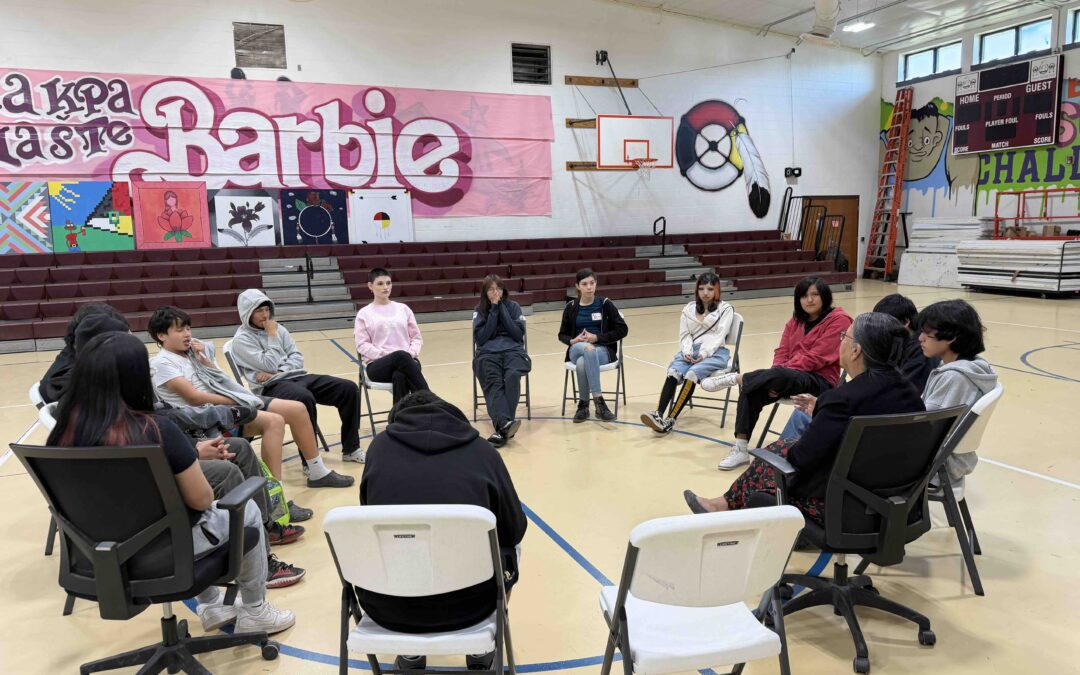
For the Cheyenne River Youth Project, teaching traditional arts and Lakota language is about more than passing along knowledge. It’s also about building relationships between generations, and feedback from the organization’s second annual Oceti Sakowin Youth Conference suggests those connections are taking root.
Held at the youth project’s Cokata Wiconi (Center of Life) Teen Center on Oct. 17-18, the free conference brought young people together with Native instructors for two days of traditional arts, Lakota language and cultural teachings. To assess the gathering’s impact, CRYP collected 46 youth reflections, eight instructor surveys and 30 classroom observation reports.
In the youth reflections, nearly six in 10 young people reported feeling much more comfortable with instructors and elders. Half identified art and hands-on creation as their favorite experience, and more than half said they wanted to try new things or create something of their own at a future conference.
“We get feedback from the kids after every program we do, including our teen internships,” said Wakinyan Chief, CRYP’s arts manager. “We encourage them to be honest and tell us what we can improve, and we take their feedback very seriously.”
Nineteen youth also reported substantially greater interest in Lakota culture. Others described feeling closer to their peers and more confident about their futures.
Those connections weren’t limited to formal instruction. Classroom observers recorded young people sharing stories, discussing their lives and engaging in casual conversations with instructors. In one instance, a participant took what he had learned in a Lakota language workshop and practiced speaking with an elder during lunch; another young person stayed for an additional 30 minutes after a session ended, talking with instructor Jeremy Fields and even asking for his autograph.
“The youth responded really well to our traditional arts and language activities,” Wakinyan Chief said. “They’re letting us know they want more of these learning opportunities. And when I asked my art interns if they wanted us to keep offering the youth conference, they were very enthusiastic!”
For some participants, the most memorable experiences were simple moments of connection. One youth recalled “hanging with new people and making new friends,” and another participant recalled learning how to greet others and converse in Lakota.
Others highlighted the opportunity to work with their hands and develop new skills. One participant wrote, “I really enjoyed making tea and learning what they are all for.” Another shared, “Earring making was so fun, and I learned new tricks that can help me in my beading.”
Classroom observations revealed how that enthusiasm translated into participation. During a beading workshop, young people moved from watching demonstrations to trying new techniques, helping classmates and working through challenges. In an art session, participants asked how to incorporate personal details, including earrings and necklaces, into their drawings.
In Lakota language instruction, youth practiced speaking and took notes without being prompted. During cultural activities led by elders Manny and Renee Iron Hawk, they volunteered for games, asked questions and actively participated in the discussions.
“We definitely observed that young people became more engaged when they were doing activities rather than listening to presentations,” said Jerica Widow, CRYP’s programs director. “So we considered different teaching approaches, such as asking youth to read the material aloud and learning by doing.”
The instructors came away with new perspectives as well. Seven of the eight respondents reported feeling strongly inspired by their interactions with the youth, and five reported feeling a similarly powerful sense of hope.
Renee Iron Hawk recalled that when participants were invited to submit questions anonymously, the questions were serious and carefully considered. Other instructors described young people who were actively seeking personal guidance and demonstrating curiosity about cultural teachings.
Reflecting on the challenges facing some participants, instructor Jeremy Fields asked, “How do we give them courage to be bold?”
Conference feedback also offered direction for future CRYP programming. Seventeen youth expressed interest in spending more time with other young people, 16 wanted to learn more from instructors or elders, and 11 hoped to explore more Lakota culture.
In their feedback, instructors proposed larger hands-on projects, additional language classes, traditional arts instruction and mentorship opportunities. Some suggested shorter cultural classes throughout the year to expand access for youth who cannot participate in CRYP’s longer-term internship programs.
For Wakinyan Chief, these insights reinforce the youth project’s ongoing commitment to providing year-round opportunities for cultural education and mentorship. As CRYP plans future workshops and cultural activities, participants will help guide what comes next.
To learn more about the Cheyenne River Youth Project and its programs, and for information about making donations and volunteering, call (605) 964-8200 or visit lakotayouth.org. To stay up to date on the latest CRYP news and events, follow the youth project on Facebook, Instagram, LinkedIn, Vimeo and YouTube.
The Cheyenne River Youth Project, founded in 1988, is a grassroots, nonprofit organization dedicated to providing the youth of the Cheyenne River Sioux Reservation with access to a vibrant and secure future through a wide variety of culturally sensitive and enduring programs, projects and facilities that ensure strong, self-sufficient families and communities.