
When Nation Cowins first walked into the Cheyenne River Youth Project’s Cokata Wiconi (Center of Life) Teen Center at age 13, he was simply looking for something to do after school. What he found instead was a pathway.
Today, Cowins — whose Lakota name is Sunkawakan Wakinyan — works full-time at CRYP as a programs specialist, helping guide the next generation. This spring, he is leading a new cohort of Lakota Culture interns, continuing a journey that began years earlier when he first walked through the teen center doors.
Cowins’ story reflects the evolution of CRYP’s youth programming. What began more than a decade ago as a series of short-term internships has grown into a structured workforce development pathway designed to help young people build confidence, responsibility and leadership skills.
“Nation is exactly why we created the Youth Employment Initiative,” said Julie Garreau, CRYP’s founder and chief executive officer. “When he and his peers started showing up in increasingly large numbers for our internship program, we knew we needed to create the next steps in education and mentorship so they could continue to learn and grow.”
Cowins grew up in Eagle Butte, South Dakota, but he didn’t discover CRYP’s programming until his early teens. He immediately gravitated toward hands-on learning opportunities in the youth project’s Native food sovereignty, Native wellness, Indigenous cooking and art internships.
“The different types of programs were appealing for me,” he said at the time. “Especially the garden and cooking.”
He completed multiple internships over the years, gaining valuable hands-on experience and discovering new interests while building relationships with staff. Like many Cheyenne River teens, he discovered that CRYP offered a safe and creative space to learn practical skills while staying connected to culture and community.
When CRYP launched the Youth Employment Initiative in 2023, Cowins was among the first teens to join the program. It was the next logical step for an older teen who completed multiple internships and was ready to grow.
“Through YEI, our teens develop workplace readiness skills, explore career interests and take on increasing responsibility through paid roles,” Garreau said. “They also learn to work as a team — as a cohort and alongside our staff.”
When Cowins completed the program, he transitioned into a full-time role on CRYP’s programs team. This milestone reflects YEI’s long-term goal of helping teens move from program participants to capable young adults ready for employment, leadership and community contribution.
As Cowins’ responsibilities grew, so did his opportunities to represent his community. In September 2025, he traveled to California with CRYP to attend Block’s “Block x Block” 16th anniversary event; the youth project has a longtime partnership with Square, the company’s flagship brand.
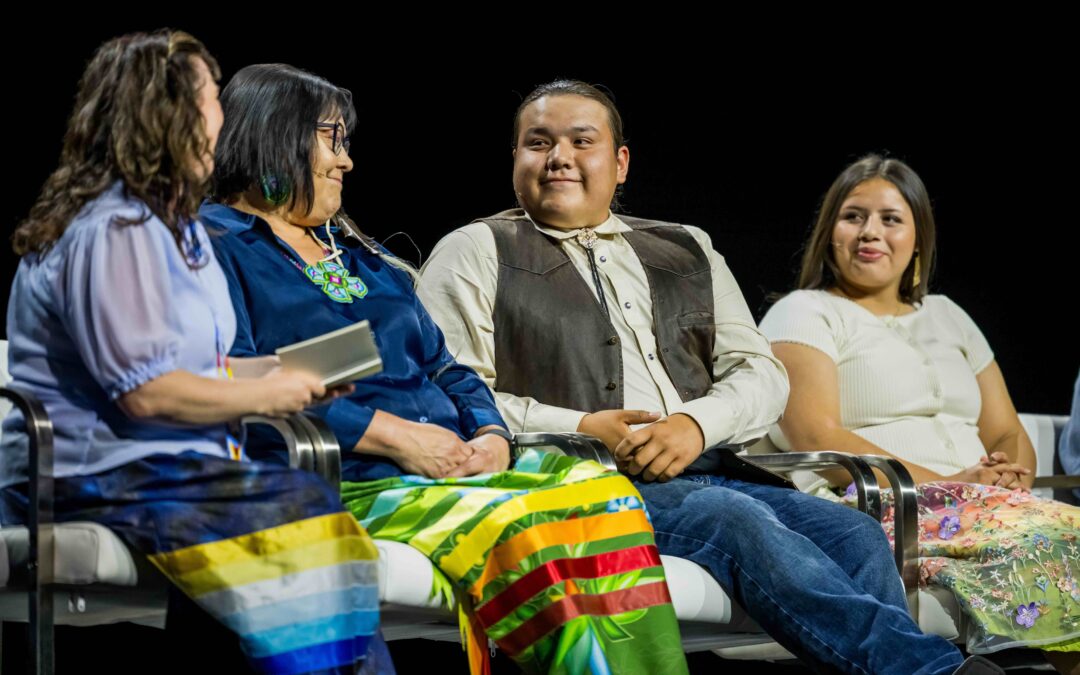
Together with Garreau and teen intern Gabby Dupris, Cowins addressed an audience of several thousand people at the Oakland Coliseum about his journey and the importance of Lakota youth leadership. (He is pictured here with, left to right, moderator Erin Archuleta, Julie Garreau and Gabby Dupris in a photo provided courtesy of Block.)
“It was such a good experience for me,” he said. “It meant a lot, to be able to do that — to use my voice and be open about what life is like for youth in our community.”
One of the more recent opportunities for Cowins came this winter, when he led CRYP’s Native Food Sovereignty Internship. As part of the program, his group of 11 interns ages 14-17 traveled to the Pine Ridge Indian Reservation on Feb. 20 to see real-world examples of Lakota-led innovation at Makoce Agriculture Development in Porcupine and at Bryan Deans’ off-grid eco-ranch in the Slim Buttes area.
Starting April 1, he will lead a cohort of 15 young men in the spring Lakota Culture Internship, a five-week program that includes a healing camp at Wakaneja Kin Wana Ku Pi (The Children Are Coming Home), CRYP’s nearly 40-acre property adjacent to sacred Bear Butte. Online registration for the internship opens March 23.
Cowins said he is looking forward to leading his second internship. While he initially felt nervous to take on this important role, he said it has been a positive experience overall.
“It’s great to get to know the kids, and it’s fun to watch them and realize they’re the same age I was when I started,” he said. “I look back a lot.”
Cowins is not the only young adult following the YEI pathway from internships to leadership roles. A fellow trainee from his cohort, Wambli Gleska Quintana, was selected from a nationwide pool of applicants to join the 2024 Champions for Change team — created by the Center for Native American Youth, a policy program of the Aspen Institute — and also won a prestigious Gates Scholarship.
Quintana is currently in his second year of college and hopes to become a lawyer. He recently returned to CRYP to teach a financial literacy workshop at The Main, the youth project’s center for children ages 4-12.
Meanwhile, YEI trainee Johnny Blanco is in the process of transitioning into a full-time staff role at CRYP.
“We’re incredibly proud of Johnny,” Garreau said. “He is working in our administrative office, assisting our finance manager and gaining valuable experience in nonprofit operations and financial management.”
For the CRYP team, the successes of Cowins, Quintana and Blanco reflect the long-term value of investing in youth development from childhood through young adulthood. In Lakota communities, that investment also emphasizes healing, cultural reclamation and language revitalization.
“Our goal has always been to help young people discover their strengths and see themselves as capable leaders and culture bearers,” Garreau said. “When our young people thrive, our Lakota communities become stronger and healthier. That’s the impact we’re working toward.”
She said Cowins’ story represents a journey coming full circle. The same organization that welcomed him as a curious young teen is now the place where he mentors others — and sets an even higher bar for himself.
“He tells me all the time that he wants to have my job one day,” she said with a smile. “I love that, especially because he’s now helping create that same sense of possibility for other young people. It’s a beautiful thing to witness.”
To learn more about the Cheyenne River Youth Project and its programs, and for information about making donations and volunteering, call (605) 964-8200 or visit lakotayouth.org. And, to stay up to date on the latest CRYP news and events, follow the youth project on Facebook, Instagram, LinkedIn, Vimeo and YouTube.
The Cheyenne River Youth Project, founded in 1988, is a grassroots, nonprofit organization dedicated to providing the youth of the Cheyenne River Sioux reservation with access to a vibrant and secure future through a wide variety of culturally sensitive and enduring programs, projects and facilities that ensure strong, self-sufficient families and communities.